
Shengliver’s Note: My home was renovated in the summer holidays. The other day I re-sorted my library, and all the books, ancient and new, found their proper places on the brand-new bookshelves. Each book itself is a story, and some evoke memories that make me smile or make my eyes moisten. The library stands a reminder to Shengliver of the long way he has come and of where he’s heading for.
Picture the two scenes here.
Scene One
A boy, perched on a rock by a gurgling stream, with the sun setting and a sky painted golden, was reading an issue of Chinese Folk Literature. He was so absorbed that he became oblivious of everything else about him—the gathering dusk, the grazing goats on the riverside and the peasants returning home from the fields.
Scene Two
A boy was reading Grimm’s Fairy Tales on a winter evening in the family kitchen, sitting at the stove and poking the fire. It was snug in the corner and the tales captivating.
Who was the boy?
It was me, Shengliver, in my boyhood. I was born in the country in the 1970s. Life was poor in terms of material comforts but rich in love, love from family and love from pals. Books were hard to come by in those days, and stationery was scarce when I was in Grades 1, 2, and 3, primary school. Like my classmates, I wrote on a slate using pieces of limestone, which we pupils, with the teacher’s help, quarried from a mountainside near the village. I jumped with joy when Mother bought me a proper exercise book (priced at 0.05 yuan) one day after she sold some produce at the market. I first wrote in pencil in this book. Then I reused it by writing in black ink with a writing brush, covering the pencilled characters.
The two books, Chinese Folk Literature, a periodical, and Grimm’s Fairy Tales, a Chinese translation, were not mine. I borrowed them from one of my best childhood buddies. I have no idea where he managed to get interesting books, but he was luckier probably because his mother was a cadre, connected with other cadres. Those privileged people had access to books.
The copy of Grimm’s Fairy Tales ended up in tragedy. After finishing it, I had to lend it to another reader, an older villager who had pleaded for the book a lot of times. The book never made it back to me. When I asked the older reader to return it weeks later, he said he was halfway through the book. Urged to return the book time and again, the guy finally confessed that his mother had used it as kindling in their kitchen stove. Whether it was a lie or not, the treasured book was no more. Many a tear I shed for it.
Another unforgettable memory of reading finds its roots in the college days. I attended a two-year program at the local Teachers College. During those two years, the library, the grandest in my eyes then, was a favourite place to be, when there were no lessons to attend, in the afternoons or evenings, and on Sundays. The tranquillity of the reading room and the scent of the books and magazines still linger on in my mind today. When I open a book in my study, I find my thoughts racing back to those times in the college library.
In college, I exhausted my reading skills course book. It was a series of four volumes, graded by the difficulty of the language like a ladder. Most of the contents were taken from an American graded reader, The Reading Laboratory. I devoured those plain but informative and entertaining passages. Thanks to the hundreds of hours I spent on the four volumes, my reading skills were developed, my knowledge of the English language broadened and my vocabulary enriched. The best place where I did the four books was the ground-floor lecture theatre. On Sundays the hall was open but very few or none of the students went there. Therefore, I found it even better than the reading room, no schoolmates around and birds twittering in the wood outside. I keep the four volumes in my study, whose pages, notes scribbled in the margin and between the lines, give Shengliver an enormous sense of accomplishment.
Picture another scene.
On Sunday morning, at a second-hand book market, a family of three—father, mother and daughter—are hopping from one book vendor to another, reading some here and picking up a book there. The daughter is a toddler, and her eyes are riveted on some baby pictorials. When they leave, each of them takes away their favourite read.
Who are they? They are my family.
I bumped into the 4 or 5 second-hand book vendors around 1999 in my city. The first encounter left me with a Reader’s Digest. It was a back number, but in this small regional capital of China, it is next to impossible to get an original Reader’s Digest. Since then, I have visited those few vendors regularly, usually on Sunday. The vendors are mostly migrant workers from rural Henan Province.
I have accumulated several hundred English readers in this way. The books are good and old. And cheap, too. Before I got wired in 2004, those several hundred readers provided me with plenty of English reading materials for the spare time. Some of the books were published even before 1949 in China. Luckily enough, some readers, printed and bound in the USA or Britain, ended up in this town of mine and became part of Shengliver’s home library. H G Well’s The Outline of History, published in 1921 New York by the Macmillan Company, was such an example.

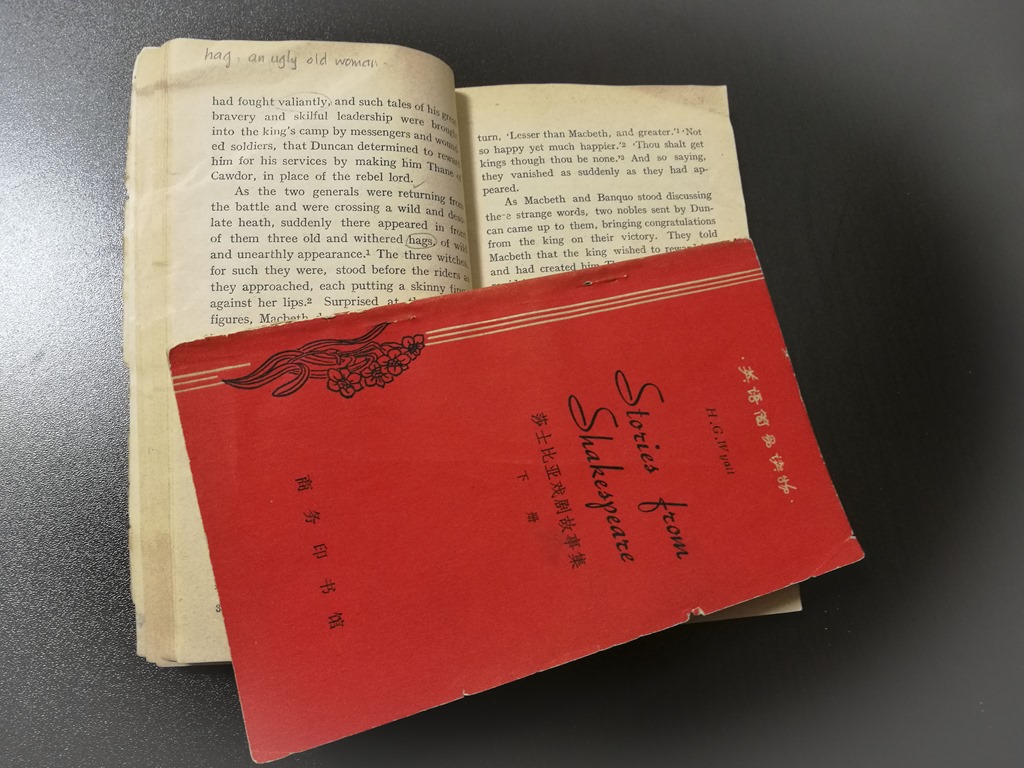
In the bookshops today, Chinese readers can choose from elaborately bound books, printed on glossy paper with state-of-the-art tech. Some of the books which I scavenged at the book market reflect the economic circumstances of the time they were printed and bound. A 2-volume set of Stories from Shakespeare (author H G Wyatt) on my bookshelf was printed in 1964 Chongqing and published by the Commercial Press Beijing. For a lack of resources, the book was done in small print on poor-quality paper. The set, little and compact, contains all the stories there should be. The price tag says it sold at 0.47 yuan a volume. In 1964, most Chinese certainly could not enjoy the luxury of fancy books. Putting three meals in the bowl every day was a paramount concern to an ordinary family then. The same book would now cost at least 50 yuan if well printed and packaged.
Most visits to the vendors are fruitful. The vendors and I have got to know each other and they know where my interests lie. After exchanging pleasantries with me, they show the books they have collected. Of course, there are occasions when I exit the Sunday flea market empty-handed.
My daughter benefited from this Sunday book-hunting trip. She has collected a lot of children’s readers. Some are quite new, but most old. Fascinated by the stories, my girl surprised me one day when I mentioned the name Charlotte Bronte. She gave me a lecture on the family, the three sisters and their literary talent. I asked her how she had come to know it. “I read it in one of the old books,” she giggled. She told me that probably she has the largest home library of all the children in her class. The first time she met the vendors, she was no older than a toddler. She is a 4th grader.
The itinerant vendors are honest and hardworking. They have no fixed venue for their market. They move from place to place, driven by the City Supervision Squad (a branch of Chinese police), who blame them for dirtying the city image by doing their business anywhere they like. The books are simply stacked on plastic on the pavement, and they sit there from dawn until dusk. When it rains, business stops.
Much of my reading takes place on the computer these days. I run some digital libraries on my PC, but still thumbing through the pages of a paper book and reading it over a cup of tea is one of the simple pleasures I will definitely be relishing in the years to come.
 Shengliver Studio