
Shengliver’s Note: My former classmate Ms Zhu Yufen killed herself after she delivered a baby girl. What caused her death? Was it Chinese prejudice against girls? Was it the harsh family planning policy, which was initiated by the government in the 1970s? Or was it her own weak will? In this entry, which was posted for the first time in 2005, Shengliver tells her story, reflects on rural Chinese problems, and recalls the country school we attended in the mid-1980s. It was not until 2021 that the national family planning policy was finally abolished.
Her Story
I had a female classmate in junior high school. Her name was Zhu Yufen.
Miss Zhu’s village was about 2 kilometres from mine. Besides, I passed her farmhouse en route to school. In time, we got familiar with each other and were on good terms. She had one brother and three or four sisters. It was a large family. Her mum died young, leaving the father rearing them all.
In Grade Three, Junior High, she and a boy from another village got romantic. At least I thought so. The boy had a bicycle, which was still a luxury for most Chinese teens in the 1980s. He offered Miss Zhu free rides on the bike to and from school. We all thought they would tie the knot someday.
Unluckily the boy, who passed the high school entrance exam, was enrolled in the county high school. Their romance came to an end. They parted from each other. The boy attended a polytechnic after high school, and landed a job in the city upon graduation. Miss Zhu, left behind in her village, remained a farmer.
Zhu Yufen, through a matchmaker, was spliced to a lad in a village near my home. The boy’s home is located in Henan Province while Zhu’s and mine are in Hubei Province, for my home village almost straddles the boundary.
I was in college when Miss Zhu got married. I learned about it the first winter vacation. It was said to be a happy match for the boy’s family was well off. I didn’t see any of her in person in my college years.
The next winter vacation I asked Mum about her. Mum said, “Yufen has committed suicide.”
It happened like this. Her life seemed to be a happily-ever-after affair initially. Her husband and her in-laws treated her very well. Yufen had good looks. Things, however, changed after her baby came to the world. It was a girl, a healthy girl.
It was a girl who was despised by the family. Her husband was the only son of his parents. In Chinese traditions, he was supposed to extend the family line. The birth of the baby girl soured the family’s attitude towards Zhu Yufen, for everyone had been expecting a boy. My readers might say Zhu could have given birth to more babies if she had liked. At that time, unfortunately, a family would have to pay a fortune to bring a second or a third child to the world. Besides, a stigma was attached to violating the state law on family planning. Government officials enforcing family planning policies were harsh. They could impose a heavy fine on the violator. They were empowered to confiscate his property such as furniture and grains if the family could not afford it.
The cold attitude drove Zhu down into depression. Before the baby was one month old, Zhu took her own life, drinking pesticide the family had reserved for their crops.
She died, leaving her baby in this world. I don’t know how the family felt. I know how I felt when I heard Mum telling me her story. My heart went out to Yufen, for we used to be in the same classroom as preteens.
Social Problems in Rural China
The family planning policy was successful in curbing the explosive growth of the Chinese population, which resulted from the government policies of the first two decades (1950s and 1960s) of the new republic. The grim side of the picture is that doubtlessly some local government officials were not able to implement the policies humanely. Zhu’s story is an indirect reflection of it.
These days, in Chinese villages, especially in central and western parts of the country, breadwinners of a peasant family are absent, with grandparents caring for the young. The absence of parents creates huge problems for the growth of their children.
Chinese peasant wives still live wretched lives in many cases. A lot of them are poorly educated, burdened with heavy household duties, and ignorant of their rights. As a result, they suffer from a myriad of psychological problems. Who can go out and offer them a hand? What role should the Chinese education system play in making a difference to country girls, most of whom are to become peasant wives in time?
The Country School
Miss Zhu and I attended the same country school in the mid-1980s. The school served all the villages in my People’s Commune (later renamed Township).
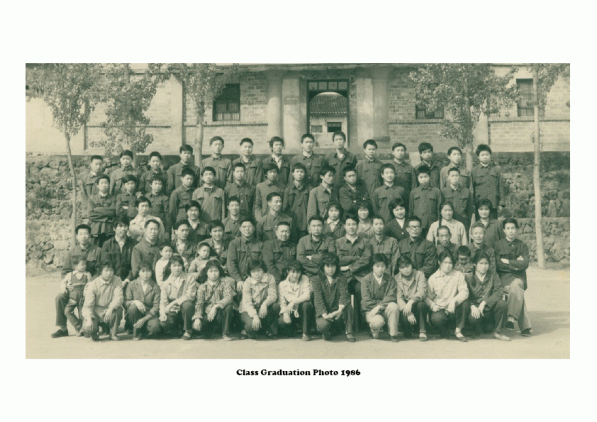
It was kind of a boarding school, where the living conditions were horrible. Infrastructure and basic facilities were lacking. We carried firewood and grains from home to the school kitchen. We studied and stayed at the school for a fortnight before we had a two-day break. Meals served in the school kitchen, if it could be called such, were neither nutritious nor sufficient. We had cornmeal porridge for breakfast and supper, and noodles for midday. There was no rice, no bread, no meat, no vegetables whatsoever on the menu. In summer and autumn, there were a lot of worm carcasses in the soup, yet we had no choice but to swallow the unpalatable stuff, with pickles our parents had prepared and jarred for us back home. Most days, I was starving. There were many occasions at night when, driven by hunger, my mates and I, under cover of darkness, sneaked away to the patches near the schoolyard, where we helped ourselves to garden vegetables like radishes and potatoes. It was robbing the farmers!
There being no dining hall for the pupils, we had to eat in the open air. It was OK when the weather was fair. It was hell when the weather was foul. On wet days, those of us without an umbrella had to shelter under the eaves at mealtimes. Those with an umbrella stood and ate in the rain. Still the clothes were often wetted by the precipitation.
Despite hunger, we had to labour every now and then for the school. The school would have more schoolrooms built one year, so we students had to make adobe bricks of mud and grass for the construction, and to port sand and stone from a river valley to the school with baskets and poles. One morning, the whole school set out for a forest deep in the mountains, from where we fetched felled trees to be used as beams of the new schoolhouse. I remember trekking in the mountains with my schoolmates for a whole day. There was no meal at midday. By the time I approached the school, trailing two cypress trees behind me, the sun was fast sinking below the horizon.
All the boys in my class, around 30, slept on one bed in one room with one window. The window was iron barred with no glass panes. In winter it was covered with plastic; in summer nothing at all. Thus, insects were free to come and go. (The classroom windows worked the same way). Looking back, I do feel that the main function of the dorm was no more than a roof over our heads. The bed was in reality several wooden boards assembled on adobe bricks. A skin disease called scabies infected all the boarders. The itch kept us scratching all over the body. The scratches festered, swelled and filled with pus. Lice and fleas were rife where we laid our bodies down at night. Our quilt, clothes and hair were infested with bloodsuckers. The lavatory was a hole in the ground.
There was no clean drinking water for us. When we were thirsty, we went and drank from a spring somewhere near the school. We washed our eating bowls in a ditch, which channelled water to a small hydroelectric power plant. For some time, especially in rainy autumnal days, everyone seemed to be suffering from diarrhoea. In winter, we had no warm water. We had to wash ourselves in the freezing channel. The spring water felt a bit warm in winter if we were willing to take the trouble to visit it. Occasionally the cook provided warm water in the meal buckets for us to wash our face with. There was not even a towel to clean and dry. Most of us ended up with inflamed eyes, especially in winter and spring. Chilblains were prevalent among the pupils.
Those days!
 Shengliver Studio