
Shengliver’s Note: This Chinese farmer, Quanlaotour, is dead, yet his spirit lives on. In times of confusion or disheartenment, he is out there, serving as a beacon. Quanlaotour, the title by which he was addressed by his fellow villagers, literally means Quan the Elderly Man. Quan was the family name.
We come across the multitude by the thousand in a lifetime, yet only a small number stay on in our memory. The majority fade into oblivion as time goes by.
Quanlaotour is a character whose idiosyncrasies have been etched on my mind since I was a boy. He was a Chinese peasant, eking out a living through subsistence farming. I never saw his wife, for she had long been gone. His only daughter was a bit mentally retarded, talking with a stutter. This daughter of his was not married out of the family. She had to extend the family line, so a lad Zhao wedded into the Quans. Zhao fathered two daughters, both of whom carried the family name Quan instead of Zhao.
Quanlaotour stood out among the peasants. All the folk in the hamlet said that he had lots of ink in the belly, meaning he was well read. His family had been affluent when Quanlaotour was young, thus affording him an opportunity to study Chinese Classics under a private tutor. Aloof from the fellow villagers, he seemed quite contented with himself. Anytime I saw him, he was humming a tune, staring into space, or murmuring to himself.
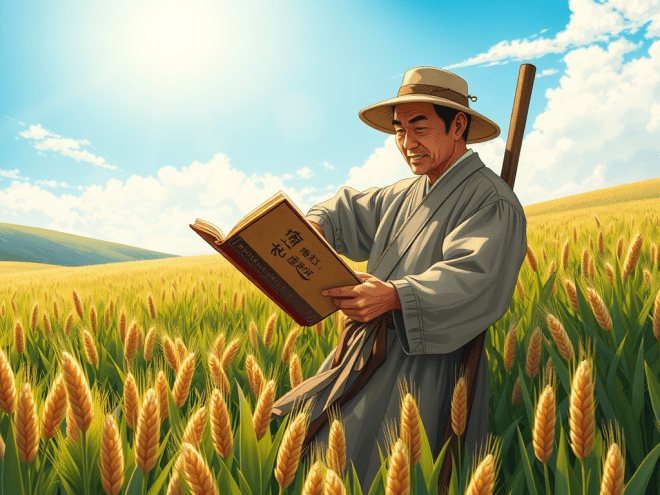
My best memory of Quanlaotour is as follows. On many a spring day, either in the morning or in the afternoon, when the sun was nice and warm, he was tending his wheat crop, hoeing or weeding or fertilising. When he was tired, he would stop and rest himself against the hoe, standing right in the middle of the field. A book was magically produced from under his baggy robe. Then and there, he was reading, sometimes aloud, most times silently. What a picture! All the quiet, all the fresh verdure, all the warm breeze, a Chinese peasant who lost himself in a book, basking in the sun. Occasionally I found him waving his arms in the air.
Books were hard to come by in those days. His books were old style thread-bound novels, and they were dog-eared, read and re-read. One of his favourites was The Legend of Three Kingdoms. No one was able to borrow the paper treasures from him. His books and his relish for them aroused my curiosity about the magic of reading.
One year he had a row with his son-in-law, Zhao. I have forgotten what it was about. Quanlaotour thought he was a civilised man, superior mentally to his rough-mannered son-in-law, who was illiterate. Instead of confronting the son, he vented his anger by scribbling curses on slips of paper and pasted them everywhere on the cottage walls in the village. In fact, the slips were so tiny that I was afraid that few ever noticed them. I happened to find one and told my dad about it. Cautioning me not to advertise my discovery, Dad directed me to tear off the slips if I found more. I found more indeed on other walls and did as I was instructed. Had Zhao been able to read, according to Dad, father and son would have been at each other’s throats.
The reason time will never erase Quanlaotour from my mind is something else, though. He was a devout Taoist. Every year, usually in the autumn, harvest done, he would go on his yearly pilgrimage to Mt Wudang, a holy mountain of Taoism in China.
This journey was not taken alone, for it was hard and long, over mountains, through vales, across streams, in fair weather or foul. He had some fellow practitioners in nearby villages. They decided upon the date of departure, then made preparations, getting ready with rations of food, clothes, several pairs of shoes, some of which were made of grass, and an oil-paper umbrella. I knew it because I happened to see this party of pilgrims embarking from the village one year on their religious expedition.

I will never forget it. Five or six of them, dressed in home-made attire dyed deep blue, each of them carrying their baggage on the back—provisions, shoes, clothing, a bamboo hat, and an umbrella—were bidding farewell to family and friends at the edge of the village.
They travelled on foot to and from the Holy Mountain. There were no modern means of transport then, no trucks, no buses, no bikes. This trek took them from 20 to 30 days, depending on the weather. On the way, I was told, they took lodgings anywhere they could, sometimes in a farmhouse, other times under the eaves, many times in a barn, and even in the open air where there were human dwellings around. Autumnal rains could add tremendously to their trials and tribulations.
In spite of the hardships, their faith paid off, for Quanlaotour was robustness incarnate. In my memory, he was never for once taken ill.
Such loyalty is a rarity today. Dedication to a vocation is laughable in many guys’ eyes, let alone devoutness to a faith. When obstacles crop up on my way, Quanlaotour pops into my mind’s eye. His pilgrimage empowers me. He undertook so hard a journey when life was far from easy. Shengliver will do better.
Where is Quanlaotour? He is dead. He died decades ago. In fact, I don’t know the exact year. He passed away probably when I was in high school or college. If the eccentric Chinese farmer were alive and knew I was writing about him in a foreign language on the Internet, he should be all smiles, with a thumbs-up to Shengliver.
 Shengliver Studio