
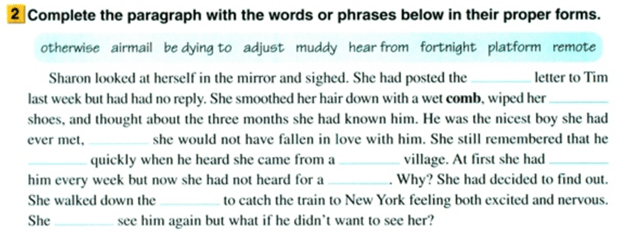
Shengliver’s Note: Teen Zijun writes a sequel to Sharon’s story, which is a cloze test found on Page 32, New Senior English for China, Book 7, by PEP (People’s Education Press).
Sharon finally set foot in New York City, the Big Apple. Seeing the skyscrapers all around and the streaming traffic on the streets, the lassie from rural America felt dizzy. Such were the hordes in the metropolis that she was at a loss as to where the very man she was seeking might be. Sharon spent three days combing the entire neighbourhood where Tim was supposed to reside according to the address on the note she gripped tightly in her hand all the time. It felt like looking for a needle in a haystack.
At last, with a bit of luck she pinpointed the right property. She knocked at the door but there was no answer. She visited the house the next day. Still, no one was in. This kept up for the next two weeks until one day she came across an elderly lady.
“Tim used to be my neighbour,” the lady said. “I regret to tell you that he has left town because his company went bust. The poor young man is up to his ears in debt. Listen, youngling, choose carefully. Maybe it is not worthwhile paying so much on your part.”
After hearing that, Sharon, dejected, decided to return to her home village.

On the train, many couples, seated together, were flirting their time away. Sharon sat by the window all alone. She stared at the fleeting tracks below, memories crowding in. Into her mind floated the scenes where Tim and she had been walking leisurely along the tracks talking about anything and everything under the sun.
In one scene, Tim confessed to her, “I got fed up with the rat race in New York. But here, Sharon, your lifestyle has helped open my eyes to what life is all about. It is you who have saved my soul. How could I go on if we were apart someday? I belong right here with you.”
Looking back on those days, Sharon remembered everything had seemed so sweet then. “Was he possibly lying to me?” the country lassie wondered, suppressing her tears. The train was rumbling through the midwestern American landscape.
When Sharon finally got back to her home in the countryside, she found an airmail letter in the mailbox. Oh, it was from Tim. It had arrived two days earlier. Totally blown away, she thought she might have been too sensitive and that she might have got Tim wrong.
With a flicker of hope in her eyes, she tore open the envelope, fingers quivering. The letter read, “I’m sorry, Sharon. My company has gone bankrupt and I am stony broke. I cannot even afford to put food on the table, but I would like to see you one more time. I am going to visit you in a week. If you don’t want to see me anymore, I will leave you for good. Will you still love me, Sharon?” Reading the familiar handwriting on paper, Sharon wept long and hard.
From then on, every day Sharon went to the local train station in her town hoping to meet her sweetheart sooner. On the third day, Tim turned up on the platform. It was a downcast Tim. The robust young man was nowhere to be found. Approaching Sharon, he gazed silently at her. Sharon broke the silence asking, “Do you know, honey, that I travelled to New York in search of you?”
“Yes, I heard about it. But Sharon,” Tim answered, “why were you so silly? I mean I’m sorry about all this. Now here I am. If you would accept me, I will leave you alone no more.”
Sharon hugged Tim before he could finish, tears all over her face, heart throbbing. They were reunited at the very train station where they had met the first time Tim came to the village five years before.
Soon Sharon and Tim got wed at the village church, and they lived happily ever after.
Every day at dusk the couple strolled along the tracks, hand in hand, watching the sun setting below the horizon and listening to the trains whistling by.
All good things must come to an end. Sharon and Tim’s halcyon days did not last very long. One morning, Sharon was found lying motionless beside the rail tracks. It turned out that she had been knocked dead by a train the night before, while crossing the tracks to feed the cattle at the cowshed on the other side.
By law, Tim came into possession of the farm, on which he made a fortune and cleared all his debts over the next two years.
Without his wife by his side, Tim no longer sauntered along the tracks in the evening. Some years later, he became neurotic. Seldom did the folks in the farming community see the widower off his land.
Tim must have been grieved to the core by the bereavement, thought the villagers.

