
Shengliver’s Note: What makes a Chinese Chinese? Festivals, because history, tradition and legend are packed in them. Duanwu is one.
What Is Duanwu?
Well known as the Dragon Boat Festival in English, Duanwu is a traditional Chinese festival. The Chinese name duan (first) wu (five) literally means the fifth day of a month. The festival falls on the fifth day of the fifth month in the Chinese lunar calendar. It is observed either in late May or in early June on the Gregorian calendar, where the exact date varies from year to year. Duanwu, kept by Chinese communities the world over, is a national holiday in China. Yet in its observance—whether in Shanghai or San Francisco, Taipei or Toronto—it remains, always, a thread back to the homeland.
Qu Yuan
It is universally acknowledged that the Dragon Boat Festival is marked in memory of Qu Yuan. Qu (343?-315? BC), an aristocrat and official of the court, was a renowned poet who lived in the Kingdom of Chu during the Warring States Period.
Over that span of Chinese history, China was not a unified nation. On the land there were a number of warring states. Chu, located in the south-central part of the land, was supposed to be the largest in area; Qin, based in what is Shaanxi today, wielded the greatest military might.
King of Chu would choose to make peace with its northern neighbour. Qin, however, was keen to invade Chu and annex it. The King of Qin coveted all the other kingdoms on the land. Aware of Qin’s ambitions, Qu counselled his sovereign to take precautions against the northern rival. King of Chu, swayed by those courtiers who were jealous of Qu’s talent and erudition, brushed off Qu’s word of caution and allied himself with his Qin counterpart. Furthermore, the courtiers smeared and vilified Qu. Qu, an upright patriotic official, ended up exiled to a remote nook of the kingdom, to the south of the Yangtze.
His country fell into decline day by day, and yet Qu Yuan was helpless. He was in anguish. His sorrow inspired him to create the great verse, Li Sao. Li Sao is recognised as the first Chinese poem of romanticism. It is narrated in the first person, a practice never found among Chinese poetry that preceded it.
In grief and agony, Qu Yuan drowned himself in protest in a river called Miluo, which is still found in today’s northeast Hunan Province.
Dragon Boat Races
On the festival, in south and central China, Dragon Boat races take place on a river or a lake as part of the celebrations. The races find their origins in the drowning of the ancient poet.
Legend goes that hardly had local folk heard of Qu’s plunging into the river when they rushed out by raft in order to rescue him. Today’s races are reminiscent of the bamboo rafts dashing across the waters to where Qu was drowning on the fifth day of the fifth month over 2,000 years ago.
Zongzi
A special food goes with a Chinese festival. Zongzi is to the Dragon Boat Festival what mooncakes are to Mid-autumn Day.
The main ingredient of zongzi is glutinous rice. This variety of rice is normally reserved for brewing rice wine. In ancient China, builders took advantage of its stickiness and applied it to construction. Mixed with sand and other building materials, it cemented bricks and stones. In my hometown, a dike along the river Danjiang is thought to have been erected this way, and the structure still functions.
The rice is soaked overnight before it is packed in some foliage, like bamboo leaves. To add more flavour, people might embed in zongzi other ingredients, like dates, raisins or meat. In my hometown, folks use the leaf of a tree called wutong (Chinese parasol tree) as the wrapping. Whatever the plant, its leaf lends its own flavour to the delicacy.
Packaged in the shape of a pyramid or a triangle, zongzi is boiled or steamed. It takes hours to have it well done.
Cooked together with zongzi, garlic bulbs are served together with the meal. Sticky rice is hard to digest whereas garlic facilitates digestion by stimulating the stomach. Thus, those with tummy complaints should be wary of zongzi. It is hard to digest.
In Hubei and Hunan, zongzi is dropped into rivers and lakes on the day. This practice traces its root to the death of Qu Yuan, too. After Qu drowned, natives there put the food in the river in the hope that the fish would eat the rice and stay away from the man’s body and thus it would be left intact. Qu Yuan’s body is no longer there, but the festive offering is cast into the river year after year to venerate the ancient patriot.
Aihao
Duanwu would be no Duanwu without a herb called aihao in Chinese. Its English name is mugwort.
Folks get up early on the festival to go and collect this herb in the country. It is placed at the door and hung about the windows. The herb is thought to be able to ward off disease and pests.
The herb features prominently in traditional Chinese medicine (TCM) and in home remedies for common complaints like skin trouble, coughing or digestive disorders.
I like the scent. It smells a bit bitter but it is refreshing. I used to mix this herb up with the chrysanthemum. The two herbs look very much alike, both exuding a bitterish aroma.
The Harvest Season
The festival coincides with early summer harvest time in central China. In my hometown, in most years, with Duanwu drawing near, the farmers are busy reaping wheat and transplanting rice seedlings in paddy fields.
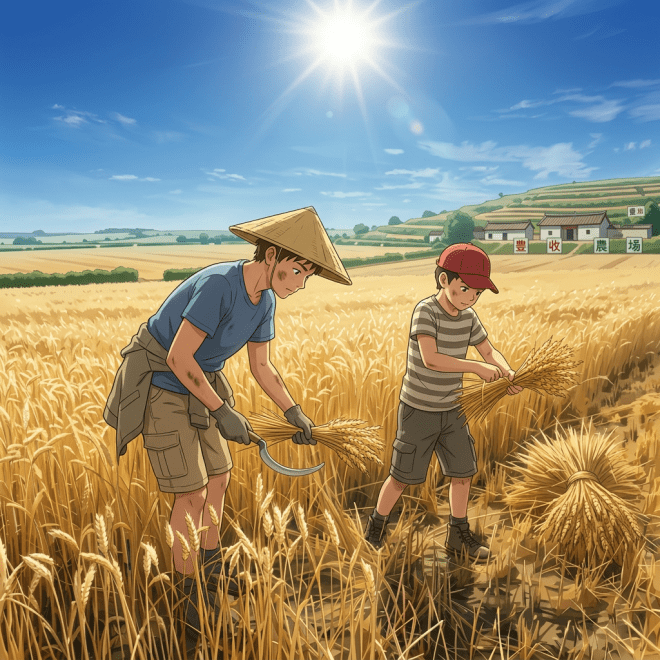
That’s part of the reason why I have no fond memories of the festival. My father and mother were no fans of zongzi. Besides, harvest did not allow them to take time to cook the festive food. As far as I can remember, my younger brother and I complained to our parents about not eating the food on the festival many years. Some neighbours prepared zongzi and it aroused our craving. One year stood out in my memory. Nagged by my brother and me, they prepared some porridge using sticky rice. It was served with sugar as a zongzi substitute. It did not satisfy our tastebuds. It was not zongzi, after all.
One year my parents finally cooked the food and treated us to it. Having finally tasted it, however, we came to a conclusion that zongzi was just so so and that pork was tastier.
My parents’ dislike of the food has something to do with the fact that the clan’s ancestry is rooted in northern China. I consulted with some elders in my village, who all said the village was started up by four brothers, who migrated here from the north in the Ming Dynasty. Northerners in China mainly consume noodles and other wheat-based dishes. Rice is the southern staple.
One festival, also in the harvest season, I was home with my parents. There was no zongzi for us in the kitchen; there was hard labour on the farm. My brother and I were woken up by our parents at the crack of dawn. We had to go and help them in the fields, sickling ripe wheat and porting the sheafs back on a long pole to the family yard. It was so early in the morning that I felt chilly and had to wear a coat to the fields. As the day progressed, the sun beat down and the temperature soared. By the time the fiery disc was high in the sky, I had to shed the coat for a shirt. All that sweating under the glaring sun! The memory of the early rising, the chill, the brisk air and the birdsong is as fresh as if it were only yesterday.

